IP Basics in Life Sciences
Last time (Vol. 6), we discussed patent litigation. The most powerful counteraction when accused of patent infringement is to “squash the patent” — that is, to invalidate it. If the patent can be invalidated, the rights that form the basis of the infringement claim disappear, and the lawsuit itself will no longer stand. Some readers may wonder, “How can you invalidate a patent right that was examined and granted by the Japan Patent Office (JPO)?” A very good question! However, even the JPO cannot conduct a flawless, perfectly airtight examination. As a result, lawsuits may sometimes be filed based on patent rights that are, in fact, invalid. Business activities should not be obstructed by rights that should never have existed. Therefore, to resolve disputes over patent rights, there is a process called the Patent Invalidation Trial. In the life sciences field — particularly in battles between brand and generic drugs — this process is often used strategically to overcome patents that hinder business.
In this volume, I will be talking about Patent Invalidation Trials.
Vol. 7: Wait, what? You can squash a patent?
– How to Defeat Patents That Block Advances in Life Science Business –
What is a Patent Invalidation Trial?
A patent invalidation trial (hereinafter “invalidation trial”) is a trial before the JPO in which the validity of an already registered patent is contested by asserting that the patent lacks patentability (grounds for invalidation). Put simply, this is a process to “squash” a patent.
“Patentability” refers to the requirements for a patent, as discussed in Vol. 3. Typical requirements include novelty (not previously known) and inventive step (progress beyond prior inventions). In an invalidation trial, these requirements serve as grounds for invalidation.
Who Can File a Request for an Invalidation Trial?
An invalidation trial may be requested by any party having an interest in the patent in question. Interested parties include, for example, a person sued for patent infringement or a person manufacturing and selling products similar to the patented invention. In the case of patents held by original brand drug companies, generic manufacturers are considered interested parties, whereas automobile manufacturers are not. The party requesting the trial is called the “petitioner.”
When Can a Request for an Invalidation Trial Be Filed?
An invalidation trial can be requested at any time after a patent has been registered. It can even be requested after the patent term has expired. As mentioned in Vol. 6, patent infringement litigation may involve claims for injunctions or damages. An injunction seeks to stop ongoing infringement, while damages can be claimed retroactively. Therefore, even if the patent term has expired, invalidating the plaintiff’s patent can be highly meaningful when damages are being sought for past infringement.
What is the process for an Invalidation Trial?
(1) Filing the Request
The petitioner submits a written request for trial to the Commissioner of the JPO, specifying the patent number and the grounds for invalidation. The Commissioner then sends a copy of the request to the patent holder. Upon receiving it, the patent holder may submit a rebuttal (written answer) or request correction of the patented invention (amendment) to maintain validity. Subsequently, a trial board composed of three board examiners at the JPO examines the arguments of both parties and summarizes the issues. Once the issues are clarified, the case proceeds to oral proceedings.
(2) Oral proceedings
Oral proceedings are held in a courtroom-like chamber at the JPO known as the trial room. The trial board sits at the front, with the patent holder on the right and the petitioner on the left, engaging in arguments much like in litigation. There are also seats for observers at the back. Oral proceedings are generally open to the public, so attending a hearing of an interesting case can be worthwhile. The schedule is published on the JPO’s website(Japanese only).
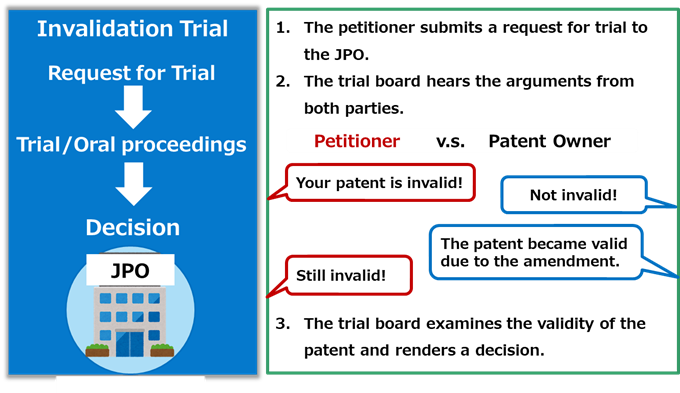
(3) Decision
After the oral proceedings conclude, the trial board deliberates. If it believes the patent should be invalidated, it issues a “Notice of Decision” (a preliminary notice indicating that, unless the patent owner raises objections, a decision of invalidation will be rendered). If the board believes the patent is valid, it issues a “Decision.” The trial ends with the issuance of the decision.
If a “Notice of Decision” is issued, the patent owner is given another opportunity to submit rebuttals or request amendments. If an amendment is filed, the deliberations continue and the same process is repeated. If no amendment is filed, a “Notice of Closure of Proceedings” is issued, followed by the final “Decision.”
(4) After the Decision
If dissatisfied with the decision, a party may appeal to the Intellectual Property High Court. This appeal is called an “Action for Revocation of the Decision.” Thus, an invalidation trial that begins at the JPO can escalate into a full-scale battle in court! The subsequent process follows the same litigation flow introduced in Vol. 6.
The patent world can indeed be intense — with patent invalidation trials developing into full-on courtroom battles! Moreover, litigation is not only used to seek injunctions or damages, but also strategically to initiate negotiations.
In the next volume, I will introduce the case of an anti–PD-L1 antibody, where litigation was used to secure substantial licensing revenue. Stay tuned!
Author Profile

Yasuko Tanaka
President & Patent Attorney, S-Cube International Patent Office / CEO, S-Cube Corporation
Outside Director, Strategic Capital Inc.; Part-time Lecturer, Tokyo University of Agriculture and Technology Graduate School; Expert Commissioner in Intellectual Property Litigation
Previously served in the intellectual property departments of Teijin, Pfizer, and 3M Japan, with extensive experience in domestic and international IP practice, IP strategy development, contract negotiation, IP education, and project management. Founded S-Cube Corporation in April 2013 to strengthen global competitiveness of Japanese companies through IP strategy, and subsequently established S-Cube International Patent Office in August 2013 to provide seamless services including patent prosecution. Holds a B.Sc. in Biochemistry from Chiba University (1990).