
Experimental Medicine Extra Edition
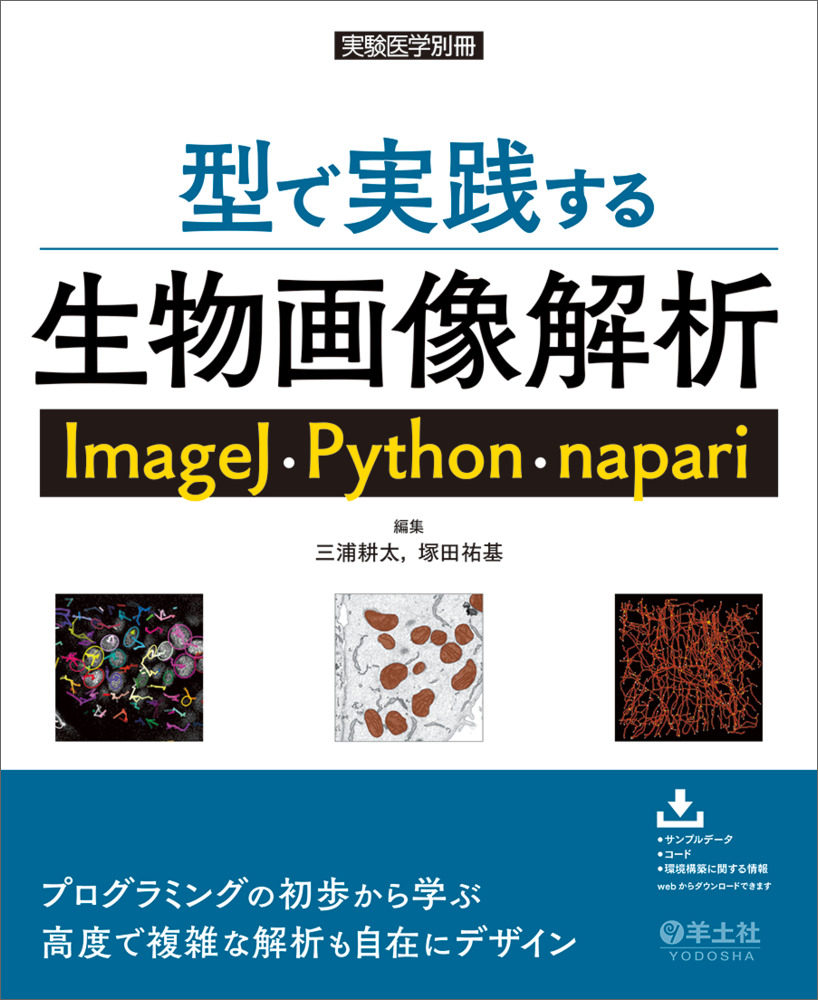
Practicing Biological Image Analysis Through “Patterns”: ImageJ, Python, and napari
For researchers who want to further enhance their image analysis skills. This highly practical textbook teaches the fundamental strategies and tools needed to design image analysis workflows tailored to your own research objectives, using “patterns” as a guiding concept. Even without prior coding experience, readers can acquire the ability to implement automated analyses incorporating state-of-the-art machine learning and deep learning tools, enabling unbiased and reproducible image analysis.
Click here for detailed information and purchasing options on the publisher’s official website.
Overview
Biological image analysis is becoming an essential technique in life science research. As analytical methods grow increasingly complex and diverse, scientific publications now require not only the names of the software used, but also rigorous and transparent explanations of the analytical processes themselves. In this book, “Practicing Biological Image Analysis Through Patterns: ImageJ, Python, and napari,” workflows used in a wide range of research projects are introduced as “patterns,” analogous to forms in martial arts, with detailed explanations of the underlying logic.
The tools covered in this book are two major ecosystems: ImageJ (Fiji) and Python. Fiji is a free, open-source biological image analysis platform that offers a vast and continuously expanding library of plugins implementing state-of-the-art algorithms. As of 2024, it is the most widely used ecosystem among life science researchers. Python, with its long history, has rapidly gained traction in biological image analysis due to the expansion of machine learning libraries and the emergence of napari, which enables GUI-based image analysis.
The book is structured into a Fundamentals section, Practical Applications section, Manuscript Submission section, Advanced Topics section, and Appendices. The Fundamentals section covers the conceptual framework of biological image analysis, workflow scripting in Fiji using Jython, the use of napari, and image analysis in cloud-based environments such as Google Colaboratory.
Table of Contents (Outline)
- Fundamentals: Introduction—Understanding the Framework of Biological Image Analysis / Basics of Jython and Workflow Scripting / Fundamentals of napari / Using Google Colaboratory for Cloud-Based Python Programming
- Practical Applications: Quantifying protein translocation to the nuclear membrane / Mitochondrial segmentation and shape clustering in electron microscopy images / Analysis of three-dimensional tubular vascular networks in tumors / Particle tracking for quantitative analysis of cell migration / Time-series analysis of the Fucci fluorescent cell cycle probe / Cell dynamics during limb regeneration in the crustacean model organism Parhyale hawaiensis / Biomass estimation from digital camera images of rice plants
- Manuscript Submission: Reproducibility checklists for image analysis and effective use of GitHub / Image data repositories and databases—mechanisms and practical use
- Advanced Topics: Microscope control using Micro-Manager / Next-generation imaging data file formats / Professional networks for biological image analysis and GloBIAS
- Appendices: List of machine learning tools for segmentation / English–Japanese terminology glossary