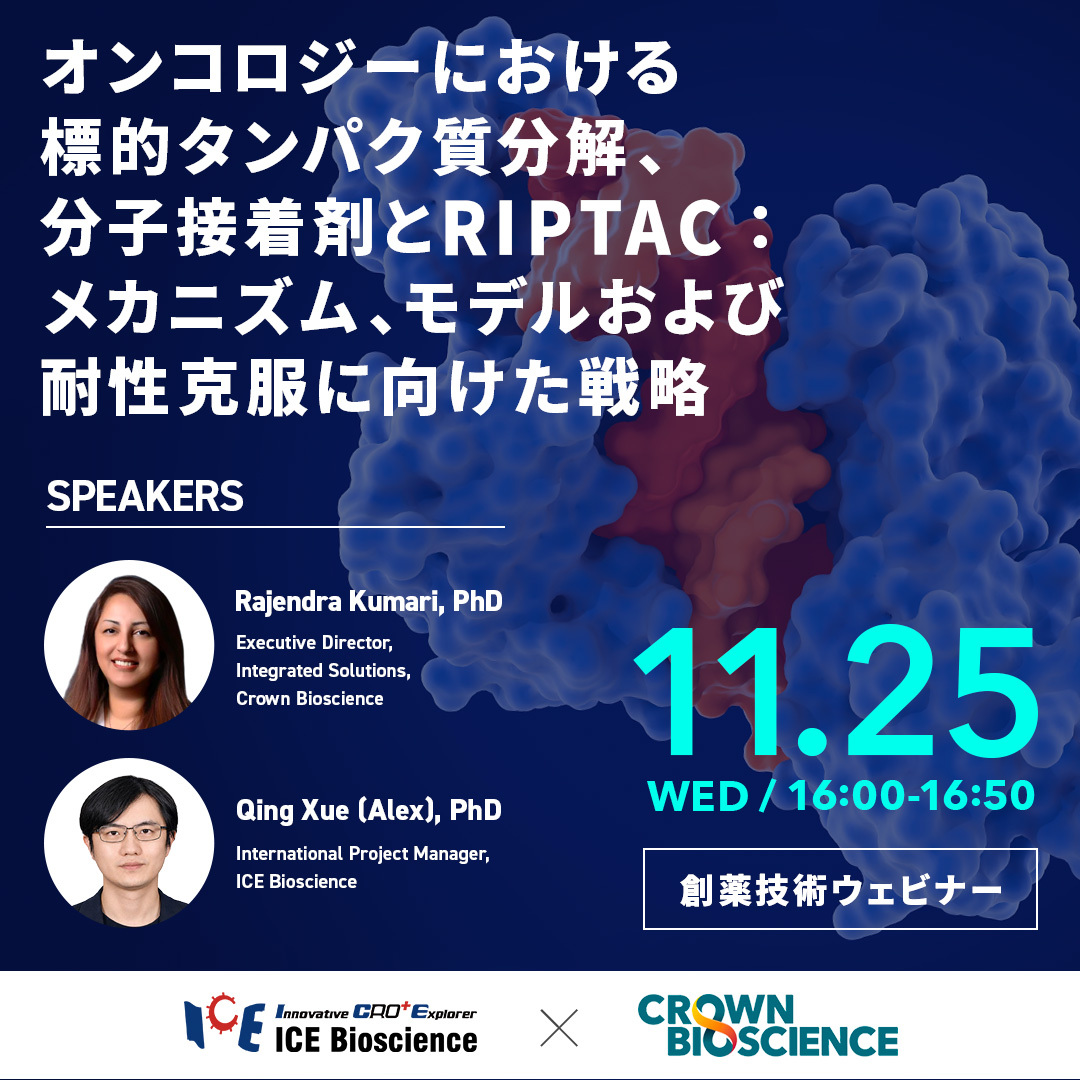
Crown Bioscience × ICE Bioscience | Drug Discovery Webinar
Exploring Target Protein Degradation, RIPTACs, and Resistance Strategies in Oncology Drug Discovery
November 25, 2026 | 4:00–4:50 PM JST | Online | Free Registration
Targeted protein degradation and proximity-based therapeutics are opening new opportunities in oncology drug discovery. Emerging modalities such as PROTACs, molecular glues, and RIPTACs offer new ways to modulate disease-driving proteins beyond conventional target inhibition.
However, advancing these therapeutic approaches requires a detailed understanding of their mechanisms of action, target and effector biology, and the ability of preclinical models to predict responses across different tumor environments. Without sufficient insight into the factors influencing drug response and resistance, selecting promising compounds and making informed development decisions can become challenging.
To explore these challenges, Crown Bioscience will host a joint webinar with Beijing-based ICE Bioscience on November 25, 2026, titled “Target Protein Degradation, Molecular Glues and RIPTAC in Oncology: Mechanisms, Models, and Strategies to Overcome Resistance.” This second collaborative webinar between the two companies will examine complementary approaches to evaluating proximity-based therapeutics, from mechanistic characterization and target–effector pair validation to translational efficacy and resistance studies.
The Potential of Proximity-Based Therapeutics and Challenges in Oncology Drug Discovery
PROTACs (Proteolysis Targeting Chimeras) and molecular glues are therapeutic approaches that promote target protein degradation by facilitating interactions with cellular protein degradation machinery. RIPTACs (Regulated Induced Proximity Targeting Chimeras) represent another emerging therapeutic modality that uses induced molecular proximity to modulate cellular functions.
Translating these technologies into cancer therapies requires a clear understanding of their mechanisms of action and the biological characteristics of target and effector proteins. It is also essential to assess how well preclinical findings predict drug responses across diverse tumor contexts.
In this webinar, experts from Crown Bioscience and ICE Bioscience will explain how complementary technologies and integrated evaluation strategies can support proximity-based drug discovery. Topics will include computational modeling, experimental assays, and clinically relevant preclinical models, including patient-derived organoids and patient-derived xenografts (PDXs), to assess target degradation, pharmacodynamic biomarkers, and antitumor activity.
Key Webinar Topics
Explore how PROTACs, molecular glues, and RIPTACs function as proximity-based therapeutic modalities. The session will address their distinct mechanisms of action and approaches to understanding target and effector biology, including validation of target–effector pairs.
Discover how AI modeling, biological modules, and biophysical and cellular assays can help characterize RIPTAC mechanisms and validate target–effector pairs. These complementary approaches support a deeper understanding of proximity-driven therapeutic activity.
Learn how patient-derived organoids and patient-derived xenograft (PDX) models can support the evaluation of target degradation, pharmacodynamic biomarkers, and antitumor activity across different tumor backgrounds. These clinically relevant models provide valuable insights for translational assessment of emerging therapeutics.
Examine how target expression, pathway dependency, degradation kinetics, and pharmacodynamic biomarkers influence the interpretation of preclinical responses. The session will also explore resistance mechanisms involving changes in target biology, degradation machinery, or pathway reactivation, and how integrated preclinical models can inform rational combination strategies, including those involving emerging targets such as KRAS.
Featured Speakers

Executive Director, Integrated Solutions
Crown Bioscience
Dr. Kumari has more than 20 years of experience in oncology research and holds a PhD in Molecular Pharmacology from the University of Leicester, UK. She previously served as an Assistant Professor in Preclinical Oncology at the University of Nottingham, where she developed in vitro and in vivo preclinical models, including patient-derived systems and imaging capabilities. She co-founded PRECOS Ltd. and subsequently held senior leadership positions at Crown Bioscience, supporting cross-disciplinary solutions for drug discovery and development.

International Project Manager
ICE Bioscience
Dr. Xue leads the development of ICE Bioscience’s Induced Proximity platform, focusing on emerging therapeutic modalities, including RIPTACs, PROTACs, and molecular glues. He has extensive experience developing biochemical, cellular, DMPK, and in vivo assays for proximity-based drug discovery. He holds a PhD in Biology from Tsinghua University and a Master by Research in Biomedical Sciences from the University of Glasgow.
Who Should Attend?
- Researchers interested in PROTACs, molecular glues, RIPTACs, and other emerging proximity-based therapeutic modalities
- Scientists investigating mechanisms of action and target–effector pair validation in oncology drug discovery
- Drug development professionals evaluating patient-derived organoids and PDX models for preclinical studies
- Researchers studying drug resistance mechanisms and rational combination strategies
- Discovery, translational, and preclinical oncology researchers seeking practical approaches to evaluating therapeutic efficacy and translational relevance
Webinar Program
Opening Remarks
Target Protein Degraders and Proximity Therapeutics in Oncology: Translational Models for Evaluating Efficacy and Resistance
Rajendra Kumari, PhD
Elucidating RIPTAC Mechanisms: In-Depth Data Mining and Target–Effector Pair Identification for Novel Proximity-Based Therapeutics
Qing Xue (Alex), PhD
Closing Remarks
*Session titles are English translations of the organizer’s Japanese program announcement.
Webinar Details
| Webinar Title | Target Protein Degradation, Molecular Glues and RIPTAC in Oncology: Mechanisms, Models, and Strategies to Overcome Resistance |
|---|---|
| Date & Time | November 25, 2026 (Wednesday), 4:00–4:50 PM JST |
| Format | Online Webinar |
| Organizer | Crown Bioscience Japan |
| Presenting Companies | Crown Bioscience and ICE Bioscience |
| Language | English (no subtitles) |
| Registration Fee | Free |
| Capacity | 300 participants (advance registration required; first-come, first-served) |
| Registration Deadline | November 25, 2026, at 12:00 PM JST |
*Questions may be submitted at any time during the webinar using the Q&A box. Responses will be provided at a later date.
Webinar Information & Registration
Explore approaches to characterizing next-generation proximity therapeutics and evaluating their preclinical efficacy, translational relevance, and resistance mechanisms.
Free Registration | Deadline: November 25, 2026, at 12:00 PM JST
Information provided by: Crown Bioscience Japan
Sources: Crown Bioscience Official English Webinar Page | LINK-J Event Announcement
*Event information and registration details are subject to change. Please refer to the organizer’s official website for the latest updates.