IP Basics in Life Sciences
So far, we have explored patents that protect pharmaceuticals, patent term extensions, and the patent battles between originator and generic drugs. In the previous volume, we compared those battles to the “Samurai Era.”
Sometimes the parties fight each other head-on over patent validity. Other times, a generic company quietly finds a way to navigate around an originator’s patent and enter the market. This time, we will look at the Japanese practice known as a “bug-eaten application” (mushikui shinsei), in which a generic slips past an originator’s patent, almost like a ninja.
Like a Ninja!?
— “Skinny Labels” Slim Enough to Slip Past Patents—
Carving Out Only the Patented Indication — The “Bug-Eaten Application”
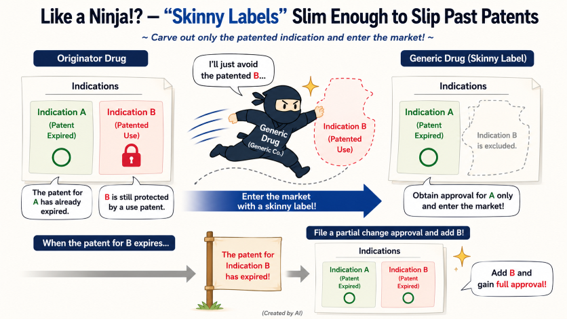
As a general rule, the indications, dosage, and administration of a generic drug must be the same as those of the originator drug. However, even when a patent remains in force for some of the originator’s indications, a generic company may obtain approval for only the unpatented indications. This practice has been permitted in Japan since 2009 and is commonly known as a “bug-eaten application” (mushikui shinsei), or an application for basic indications.
For example, suppose an originator drug has two indications, A and B. The patent covering A has already expired, while a use patent covering B remains in force. In this situation, a generic company can carve out indication B and apply for approval only for indication A. Once the patent for indication B expires, the company can then file a partial change application to add indication B.
In other words, the generic enters the market by neatly avoiding the part that is still patent protected. It really is a ninja-style way of slipping past the patent without ever confronting it directly.
Off-Label Use
So, patent problem solved! Not quite.
Once a generic enters the market with a skinny label, another issue emerges: off-label use. Off-label use means using a drug for an indication, dosage, or administration that has not been approved.
Returning to our example, the market would contain an originator drug approved for both indications A and B, and a generic approved only for indication A. The catch is that both products contain the same active ingredient. A physician might therefore prescribe the generic drug to a patient with indication B “off-label” [Note 1].
The Linezolid Case
In fact, this very issue developed into a patent infringement lawsuit in Japan.
Pfizer’s originator product Zyvox® (active ingredient: linezolid) was approved for two indications: methicillin-resistant Staphylococcus aureus (MRSA) infections and vancomycin-resistant Enterococcus (VRE) infections. Because a use patent covering MRSA infections remained in force, the generic company carved out MRSA infections and entered the market after obtaining approval only for VRE infections.
However, although the estimated number of patients with VRE infections was only several dozen per year, sales of the generic product during the first year after market entry were found to correspond to treatment for at least 319 patients.
At this point, you might be thinking: “Wait a minute. If the generic is being used only for VRE patients, isn’t that sales volume a little too high?”
That was Pfizer’s concern. It believed that the generic was also being used to treat MRSA infections and thereby infringing the use patent for which it held an exclusive license. In November 2017, Pfizer filed a patent infringement lawsuit against generic manufacturer Meiji Seika Pharma in the Tokyo District Court. How far can a use patent covering MRSA infections be enforced against a generic product that does not list MRSA infections as an approved indication? It was a fascinating question. The case, however, appears to have subsequently settled, and the court never issued a ruling on the issue.
Overseas: “Skinny Labeling”
Japan is not alone in allowing this type of approach. Similar mechanisms exist in the United States, Europe, Korea, and elsewhere, where they are generally referred to as “carve-outs” or “skinny labeling.” Patent laws differ from country to country, however, so what works for our Japanese ninja doesn’t always work overseas.
The United States, in particular, recognizes a concept that does not exist in Japan: “induced infringement.” As a result, even a skinny label can lead to patent litigation and a court decision.
One recent example is the Amarin v. Hikma dispute involving the originator drug Vascepa, in which the U.S. Supreme Court issued its decision in June 2026.
Amarin v. Hikma
Vascepa had two indications: severe hypertriglyceridemia (SH) and cardiovascular risk reduction (CV). Generic manufacturer Hikma carved the patent-protected CV indication out of its label and obtained approval only for SH before entering the market. A textbook example of skinny labeling.
Originator Amarin sued Hikma for patent infringement, alleging that Hikma’s marketing and communications encouraged physicians to use the generic product for the CV indication. The federal district court dismissed Amarin’s claims, but the U.S. Court of Appeals for the Federal Circuit (CAFC) held that Amarin’s allegations were sufficiently plausible for the litigation to proceed.
Hikma appealed, and the U.S. Supreme Court agreed to hear the case. On June 4, 2026, the Supreme Court unanimously vacated the CAFC’s decision, holding that induced infringement requires affirmative conduct encouraging patent infringement and rejecting Amarin’s allegations in this case.
Another well-known skinny-label dispute is GSK v. Teva. A jury found induced infringement in 2017, and the CAFC upheld that finding in 2021. However, the approach taken there — asking whether healthcare professionals could interpret the generic company’s communications as encouraging patent infringement — has now been rejected by the Supreme Court.
So, what do you think of this ninja-like strategy of slipping past originator patents with a “bug-eaten application,” or skinny label? Japan still has no court decision squarely resolving this issue. If another case like the linezolid dispute arises, no one knows exactly how the courts will rule. Until then, this remains one of the most intriguing areas of pharmaceutical patent law to watch.
Next time, we will turn our focus to the topic of patent term extensions that has recently become almost as hot as Japan’s scorching summer. Stay tuned!
Note 1
You may be wondering, “If a drug is used for an unapproved indication, wouldn’t it fall outside Japan’s national health insurance coverage?” Not necessarily. Under the so-called “1980 Notice,” off-label use may still be covered by national health insurance when it is considered medically and pharmacologically appropriate. The “1980 Notice” refers to the Ministry of Health and Welfare Health Insurance Bureau Director-General Notice, “Handling of Pharmaceuticals under Health Insurance Treatment” (September 3, 1980, Notice No. 51). It provides that when a drug is prescribed on the basis of its pharmacological action, medical fee claims should be reviewed on a medical and pharmacological basis rather than by mechanically applying only the officially approved indications, dosage, and administration.
Author Profile

Yasuko Tanaka
Patent Attorney, President & CEO, S-Cube Corporation / Representative, S-Cube International Patent Firm
Outside Director of Strategic Capital, Inc.; Part-time Lecturer at Tokyo University of Agriculture and Technology; Technical Advisor for IP-related litigation
Ms. Tanaka graduated from Chiba University (Biochemistry) in 1990. She has worked in the IP departments of Teijin, Pfizer Japan, and 3M Japan, dealing with domestic and international intellectual property practice, IP strategy, contract negotiations, IP education, and various project management activities. In April 2013, she established S-Cube Corporation with the aim of strengthening the international competitiveness of Japanese companies through the strategic use of intellectual property. In August of the same year, she established S-Cube International Patent Firm to provide seamless services, including IP prosecution.