IP Basics in Life Sciences
With the share of generic drug usage surpassing 80%, the rivalry between originator and generic companies has never been more intense.
As discussed in Vol. 10 and Vol. 11, originator companies have continuously developed new strategies to keep generics out of the market, while generic companies have devised their own strategies to chip away at originator patents and enter the market as early as possible.
In this volume, we look at two landmark cases where seasoned veterans on both sides clashed in court—and how the outcomes could not have been more different.
A Samurai-Era Battlefield!
– The Patent Wars Between Originators and Generics –
1. Victory for the Originator – The Maxacalcitol Case
Can you really work around a patent just by changing your manufacturing process?
Maxacalcitol, brand name Oxarol Ointment, formerly marketed by Chugai Pharmaceutical and now by Maruho, is a treatment for skin conditions such as psoriasis. Generic manufacturers entered the market after Chugai’s substance patent—the patent protecting the active ingredient itself—had expired.
However, Chugai still held a process patent: JP Patent No. 3310301, titled “Intermediate for synthesis of vitamin D and steroid derivatives and method for producing the same.” Noting that the patented process used a compound in the “cis” configuration as its starting material, one generic manufacturer opted instead to use a compound in the “trans” configuration—a different stereoisomeric form—as its starting material. The reasoning was straightforward: if the manufacturing process differed from the one described in the patent, there would be no patent infringement.
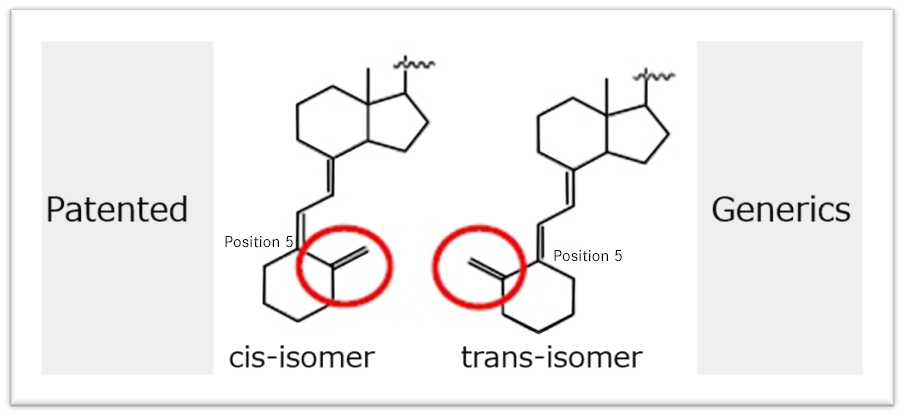
Chugai, however, disagreed, and filed suit seeking to remove the generic product from the market on the grounds that it infringed the process patent. So, what legal weapon did they deploy?
A Secret Weapon – Doctrine of Equivalents –
Chugai’s argument rested on the “doctrine of equivalents.” When a product or process falls squarely within the literal wording of the claims, it constitutes “literal infringement.” But what about cases where there is a slight difference from the claim language and literal infringement cannot be established? Under the doctrine of equivalents, if that slight difference is not essential to the invention, the product or process can still fall within the patent’s scope of protection [Note 1].
The court found that “whether the starting material is in the cis or trans configuration is not an essential element of the invention,” and recognized infringement under the doctrine of equivalents.
As a result, Chugai prevailed at all three levels—the Tokyo District Court, the IP High Court, and the Supreme Court. The case became a landmark in the pharmaceutical field as the first to recognize patent infringement under the doctrine of equivalents, sending shockwaves through the entire industry.
2. Victory for the Generics – The Pregabalin Case
A 16-company generic coalition targets a blockbuster worth over ¥100 billion a year
Pregabalin, brand name Lyrica, formerly marketed by Pfizer and now by Viatris Pharmaceuticals, is a treatment for neuropathic pain. Its annual sales in Japan exceeded ¥100 billion, making it a true blockbuster. Although the substance patent expired in 2017, a use patent—JP Patent No. 3693258, titled “Sedatives containing isobutyl GABA or a derivative thereof”—remained in force until July 2022, covering the use of pregabalin for the treatment of neuropathic pain.
In January 2017, Sawai Pharmaceutical filed an invalidation trial with the Japan Patent Office, aiming to knock out the use patent and achieve early market entry. One by one, other generic manufacturers followed suit—Towa Pharmaceutical, Nichi-Iko Pharmaceutical, Nipro, Teva, and more—until a total of 15 companies had joined the proceedings, forming a “generic coalition” of 16 companies taking on Pfizer.
The originator’s use patent falls to a written description challenge
After three and a half years of proceedings, the JPO issued a decision in July 2020 invalidating the key claims of the use patent. The ground for invalidation was failure to satisfy the written description requirements, namely violation of the enablement requirement and the support requirement.
The written description requirements mandate that the specification filed at the time of the patent application must contain sufficient disclosure to support the claimed effects of the invention. In the pregabalin case, despite claiming broad rights covering the use of pregabalin for neuropathic pain, the specification filed at the time of application was found to lack sufficient data to support those effects.
When 80 generic products from 22 companies were approved in August 2020, Pfizer filed patent infringement suits against generic companies and also challenged the JPO’s invalidation decision in the IP High Court. None of Pfizer’s arguments were accepted, however, and the invalidation was confirmed in March 2022. In the infringement suits as well, the patents were found invalid, and the battle between the blockbuster originator and the generic coalition ended in a victory for the generics.
How did you find the Maxacalcitol case, where the originator prevailed, and the Pregabalin case, where the generics won? There are many more battles yet to be told—we will introduce them in due course.
In the next volume, we will take up the topics of “carve-out (bug-eaten) applications” and “off-label use” that we touched on in Vol. 11. Stay tuned!
Note 1: The explanation of the doctrine of equivalents above has been considerably simplified for accessibility. For practical application of the doctrine, please refer to standard patent law references, the Supreme Court decision in the Ball Spline Bearing Case (Supreme Court, February 24, 1998, Case No. Hei 6 (O) 1083), and the Supreme Court decision in the Maxacalcitol Case (Supreme Court, March 24, 2017, Case No. Hei 28 (Ju) 1242).
Author Profile

Yasuko Tanaka
President and CEO, S-cubed Co., Ltd. / Representative Patent Attorney, S-cubed International Patent Office
Outside Director, Strategic Capital, Inc.; Part-time Lecturer, Graduate School of Tokyo University of Agriculture and Technology; Technical Adviser in intellectual property litigation
Ms. Tanaka has extensive experience in domestic and international intellectual property practice, IP strategy development, contract negotiation, IP education, and project management through her work in the intellectual property departments of Teijin, Pfizer, and 3M Japan. In April 2013, she founded S-cubed Co., Ltd., an intellectual property consulting firm, with the aim of strengthening the global competitiveness of Japanese companies through the strategic use of intellectual property. In August of the same year, she established a patent office to provide seamless services, including rights acquisition. She graduated from the Department of Chemistry, Faculty of Science, Chiba University, in March 1990, specializing in biochemistry.