[Part 1] AqasPrime®: A New Standard in Next-Generation Extraction and Sample Preparation Enabled by Monolith Technology
— Redefining “Sample Preparation” Through Kyoto University-Originated Innovation — AQAS Corporation


Introduction
This article introduces AqasPrime®, an emerging next-generation technology for extraction and sample preparation, in a two-part series.
When we hear the term “extraction and sample preparation,” we typically think of processes performed prior to analytical instruments such as HPLC—separatory funnels, centrifugation, solid-phase extraction (SPE), or preparative chromatography.
In the analysis of complex, multi-component samples, crude separation is usually performed before the final analytical step. However, when dealing with trace-level components in crude samples, achieving sufficient separation can be highly challenging.
In this article, we present AqasPrime® extraction and sample preparation—a revolutionary separation method that enables ultra-high resolution and has achieved complete separation of trace-level multi-component compounds—along with its practical applications.
In Part 1, we focus on the Kyoto University-originated technology behind the birth of AqasPrime®, highlighting its core monolith structure and separation philosophy.
In Part 2 (next installment), we will explore practical applications, industrial potential, alignment with the SDGs, and future perspectives.
The Origins of AqasPrime® — A Kyoto University Spin-Off Technology Emerging from an AMED(Japan Agency for Medical Research and Development) Project
AQAS Corporation is a technology-driven startup originating from Kyoto University, established following precision separation research on Panax ginseng components conducted under an AMED-funded project.
In research settings, conventional particle-packed columns used for sample preparation have long faced persistent challenges, including:
- Increased back pressure
- Flow path clogging
- Loss of trace components
- Reduced sensitivity due to matrix interference
These issues become particularly pronounced when analyzing complex matrices such as natural products, herbal medicines, or biologically derived samples.
To fundamentally overcome these bottlenecks, AQAS Corporation focused on precise control of monolith microstructures and began exploring a fundamentally different separation principle.
A New Separation Concept: “Multimodal Mode(Amphiphilic)”
Through this research process, AQAS Corporation established a proprietary separation concept known as “Multimodal Mode(Amphiphilic)” (patent pending), which enables simultaneous control of hydrophilic and hydrophobic interactions.
Conventional separation techniques typically rely on either hydrophilic or hydrophobic interactions. In contrast, Multimodal Mode(Amphiphilic) allows:
- Molecular groups with different polarities
- Under the same operating conditions
- To be separated with high precision down to trace levels
The monolith structure optimized to realize this separation philosophy forms the foundation of the AqasPrime® column.
Innovation in Sample Preparation Through a “Particle-Free” Structure
In areas where high-performance liquid chromatography (HPLC) is used for sample preparation, particle-packed columns have long been the standard. However, when handling complex matrices, issues such as:
- Flow rate limitations due to high back pressure
- Risk of clogging
- Variability in reproducibility
are difficult to avoid.
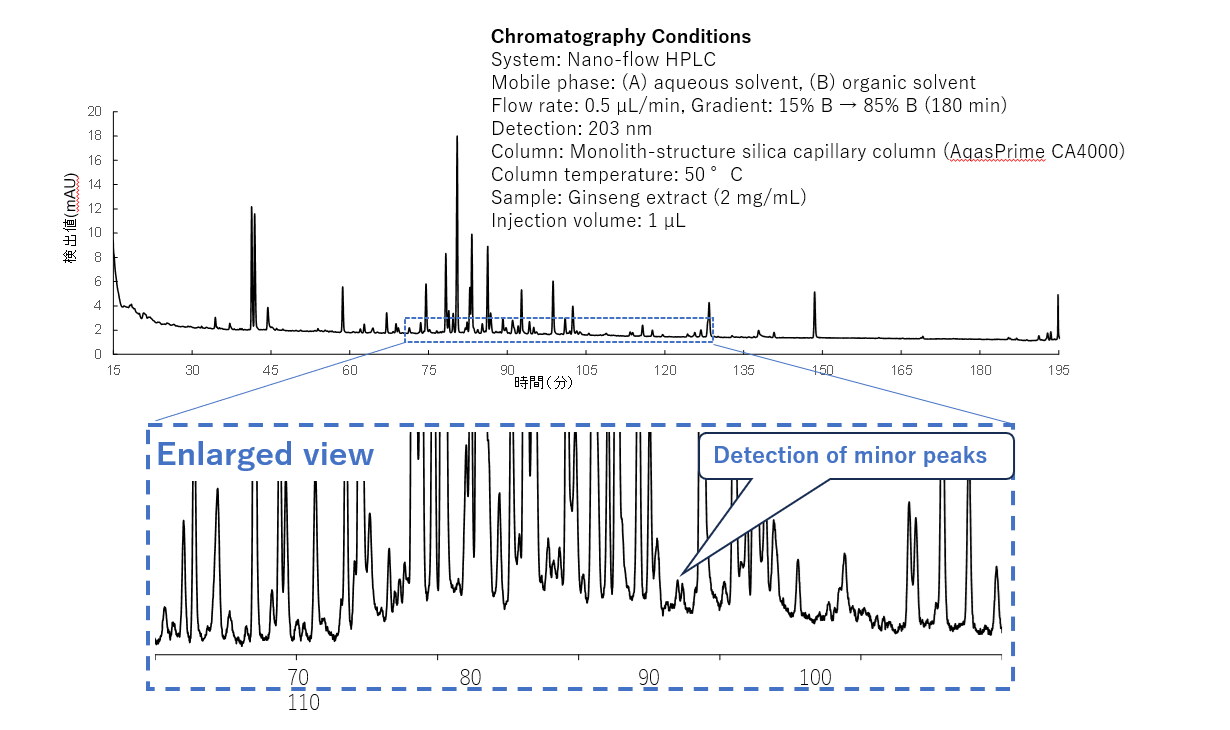
AqasPrime® adopts a continuous, particle-free structure formed by a homogeneous porous monolith. This design enables:
- Minimal increase in back pressure even at high flow rates
- Reduced clogging risk, even with viscous extracts
- Stable component retention with minimal loss of trace compounds
In addition, it offers excellent pH and solvent resistance, providing robust compatibility with diverse matrices, including food materials, pharmaceutical intermediates, and plant extracts.

“Loss-Free Extraction” in the Era of Complex Matrices
In recent years, highly accurate analysis of trace components has become increasingly important across the pharmaceutical, food, and chemical industries.
In Japan, heightened regulatory and safety awareness following the red yeast rice incident has accelerated demand for ultra-trace analysis of:
- Impurities in food products
- Screening of unknown compounds
- PFAS and residual pesticides
AqasPrime® attracts attention as a foundational technology for LC/MS analysis because its uniform internal flow path minimizes solute bias and component loss, enabling highly reproducible sample preparation even in complex matrices.
Coming Next (Part 2)
In the next installment, we will explore advanced developments of AqasPrime® technology, including:
- Micro-monolith capillaries
- Library plate concepts
- Integration with structural analysis (NMR, MS, XRD)
- Environmental contributions from an SDGs perspective
- Industrial applications and future outlook
Stay tuned for Part 2: “Industrial Applications and Future Perspectives.”
Author
Hiroaki Asaoka
President & CEO, AQAS Corporation
Born in Aichi Prefecture in 1964. Graduated from the Department of Polymer Science, Faculty of Textile Science, Kyoto Institute of Technology.
Extensive experience in management, sales, and marketing at major global companies including Pharmacia, Molecular Dynamics, Biacore, Clontech, Illumina, Sequenom (Agena Bioscience), Roche Diagnostics, Genesis Healthcare, and PacBio.
Appointed President of AQAS Corporation in October 2024.
About AQAS Corporation
AQAS Corporation webpage (EN)
https://www.aqas.co.jp/en/
Contact us (AQAS Corporation)