A New Frontier in Atherosclerosis Research Enabled by Patient-Specific Bioprinting
What is 3D Bioprinting That Transforms Vascular Model Reproducibility?
― The Latest Approach by CELLINK × LUMEN X ―
Atherosclerosis progresses through a complex interplay between vascular geometry, blood flow dynamics, and endothelial biological responses. However, conventional in vitro models have struggled to simultaneously reproduce these factors, creating significant limitations in achieving a fundamental understanding of disease onset and patient-specific evaluation.
In this webinar, a patient-specific carotid artery model constructed using CELLINK’s DLP bioprinter LUMEN X will be introduced. Designed based on MRI data and validated through CFD and PIV, this model accurately reproduces physiological shear stress distributions, endothelial cell alignment, and inflammatory responses.
Why Patient-Specific Models Matter
The onset and progression of vascular diseases are strongly influenced by individual vascular geometry and blood flow patterns.
This technology enables disease analysis that accounts for individual variability, which has been difficult to achieve with conventional models, and is expected to provide a more realistic understanding of pathology.
Key Takeaways from the Webinar
- The impact of patient-specific vascular geometry on disturbed flow and disease onset
- High-precision vascular model construction using DLP bioprinting
- Biological insights such as shear stress-dependent endothelial responses and monocyte adhesion
- Applications in mechanobiology, personalized medicine, and preclinical testing
Webinar Overview
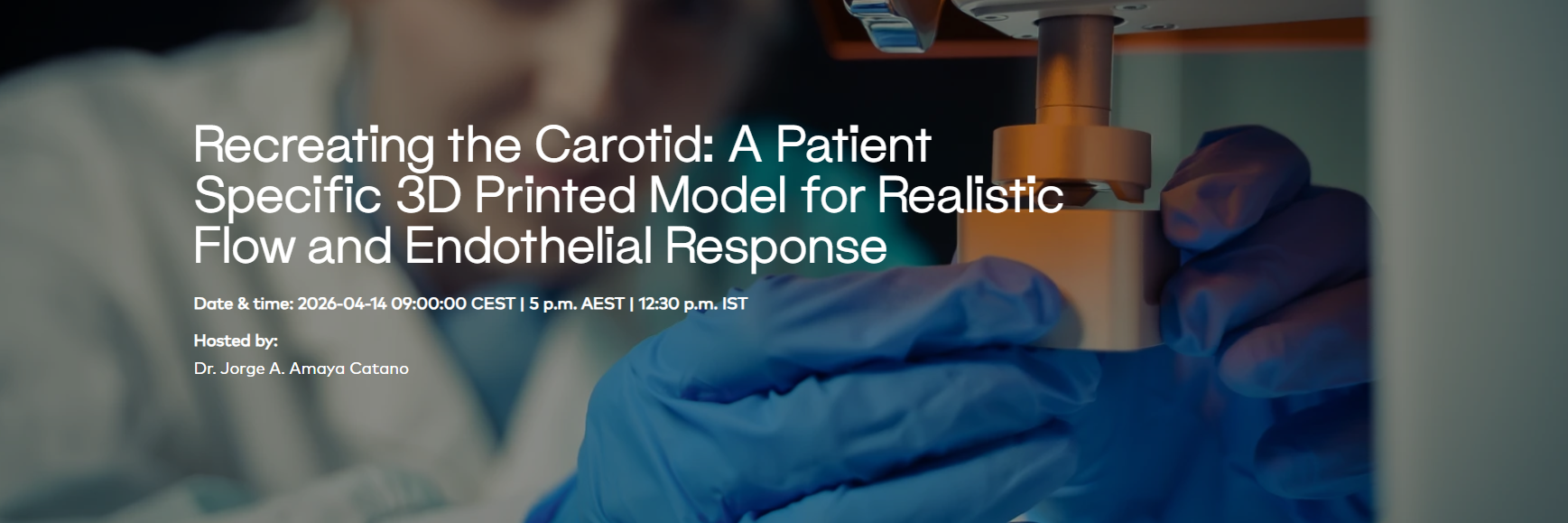
Recreating the Carotid: A Patient Specific 3D Printed Model for Realistic Flow and Endothelial Response
Speaker

Dr. Jorge A. Amaya Catano
Research Fellow, Centre for Biomedical Technologies, Queensland University of Technology
This webinar will provide a detailed explanation of the entire research workflow, from constructing vascular models based on MRI data to fluid dynamics analysis and biological validation, along with their scientific significance.
Date & Time: Tuesday, April 14, 2026
16:00 (Central European Time) / 24:00 (Japan Time) / 17:00 (Australian Eastern Time)
Registration
To participate in this webinar, please register in advance via the link below.
Register Here (CELLINK)